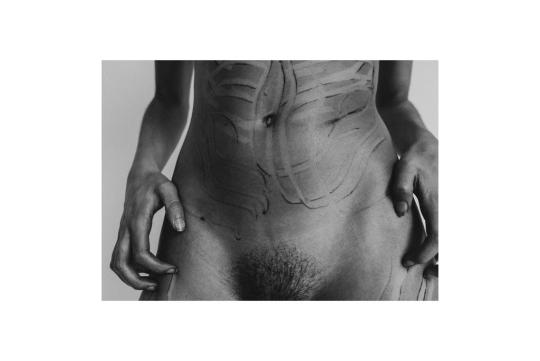
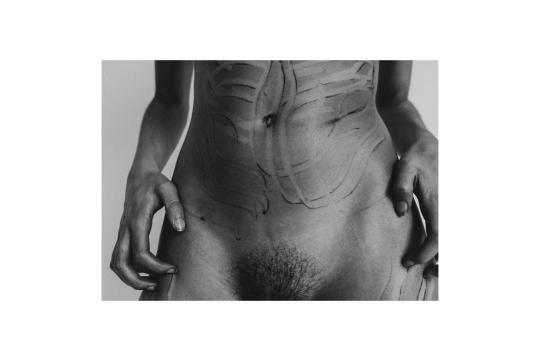
Is my body a war-ground?

Sometimes you think of this as fabric, because you see the skin fold and unfold, dry and burn, the softness emaciated as if it was nothing.
Other times you think this is what it is: only a body housing something new, something strange something like you,
but then you would have to think of yourself as a stranger and strangers have not been good to your body.

I never looked like that.

Now, her form retains barely a trace of the biped she once was. Her pupils, which seemed to have metamorphosed into shining round grapes, are gradually being buried in brown stems. My wife cannot see anymore. She can’t even flex the ends of the stems. But when I go out onto the balcony I feel a hazy sensation that defeats all language, like a minute electric current pulsing out from her body and into mine. When the leaves which were once my wife’s hands and hair all fell out, and the place where her lips had meshed together split open, releasing a handful of fruit, that sensation ended like a thin thread snapping.
The tiny fruits had burst out en masse like pomegranates; I gathered them in my hands and sat down across the threshold that connects the balcony to the living room. These fruits, which I was seeing for the first time, were a yellowish green. And they were hard, like the sunflower seeds they serve alongside popcorn as an accompaniment to beer.
I picked out one and popped it into my mouth. The smooth rind was entirely devoid of taste or smell. I crunched down on it. Fruit of the only woman I’d ever had on this earth. The first thing my palate picked up was an acidic, almost burning flavour, and the juice that clung to the root of my tongue had a solely bitter aftertaste.
The next day I bought a dozen small, round flowerpots, and after filling them with fertile soil, planted the fruits in them. I lined the small flowerpots up next to that of my withered wife, and opened the window. I leant out over the railing and smoked a cigarette, savouring the smell of fresh grass that had suddenly bloomed from my wife’s lower parts. The chill wind of late autumn ruffled my cigarette smoke, my long hair.

I want to love my body
the way I love the rain drops
that shatter themselves
on it,
the way I love the paradox of cold whiskey warming
my oesophagus on the way down

We’ll see the world together
Just as we please
Trees, they’ll shake all over
The summer breeze

I gave you my loving and I rose like the rising sun
And now I feel nothing
For without you, there is no love
Oh, my heart shines bright for you
Through darkness at noon

He saw her from the bottom of the stairs
Before she saw him. She was starting down,
Looking back over her shoulder at some fear.
She took a doubtful step and then undid it
To raise herself and look again. He spoke
Advancing toward her: ‘What is it you see
From up there always—for I want to know.’
She turned and sank upon her skirts at that,
And her face changed from terrified to dull.
He said to gain time: ‘What is it you see,’
Mounting until she cowered under him.
‘I will find out now—you must tell me, dear.’
She, in her place, refused him any help
With the least stiffening of her neck and silence.
She let him look, sure that he wouldn’t see,
Blind creature; and awhile he didn’t see.
But at last he murmured, ‘Oh,’ and again, ‘Oh.’
‘What is it—what?’ she said.
‘Just that I see.’
‘You don’t,’ she challenged. ‘Tell me what it is.’
‘The wonder is I didn’t see at once.
I never noticed it from here before.
I must be wonted to it—that’s the reason.
The little graveyard where my people are!
So small the window frames the whole of it.
Not so much larger than a bedroom, is it?
There are three stones of slate and one of marble,
Broad-shouldered little slabs there in the sunlight
On the sidehill. We haven’t to mind those.
But I understand: it is not the stones,
But the child’s mound—’
‘Don’t, don’t, don’t, don’t,’ she cried.

Looking back over her shoulder at some fear
she rescued flowers before cold
could bruise or backbend tender green into
masses of misshapen buds. All vessels—
porcelain, glass, metal—filled with
the thirst of stems cut and trimmed diagonally.
So he drank from faucets until the flowers bowed,
blushing everything bright with fallen crumbs of
pollen. Those springs smelled of rescue.
This one disturbs. Mason jars full
of dark stuck to their ringed prints in the cabinets.

We must beware of whatever insights we have into ourselves. Our self-knowledge annoys and paralyzes our daimon-this is where we should look for the reason socrates wrote nothing.

One needs to observe and experience the world with naïve, pure eyes in order to attain a great weltanschauung; — that is a living cult. — the proper tone is a book which, for some, may be nice to consult, but proves itself completely useless in the world; in other words, there are those who should live through books and those who exist through themselves; who are better? — that is clear. — Few see the sun and everyone else must read novels and novellas in order to finally realize that there is light.

Images: Henrik Latsch, Fernand Fonssagrives, @aizawa__yos(twitter), Francesca Woodman, Robert Mapplethorpe, Nobuyoshi Araki, Jana Brike, Ren Hang, Robert Mapplethorpe, Francesca Woodman, Oluchi Zotam, Zanele Muholi.
Words: anne crewe, Mahtem Shiferraw, Carol Aird, Han Kang, Marisa Crane, Octave Lissner, Alani Chiral Gibbon, Robert Frost, Grace MacNair, Emil Cioran, Egon Schiele.
Vi by Olakiitan Adeola
 SOCS
SOCS 
Zanele Muholi!